Friday 19 August 2022 kl. 19:13
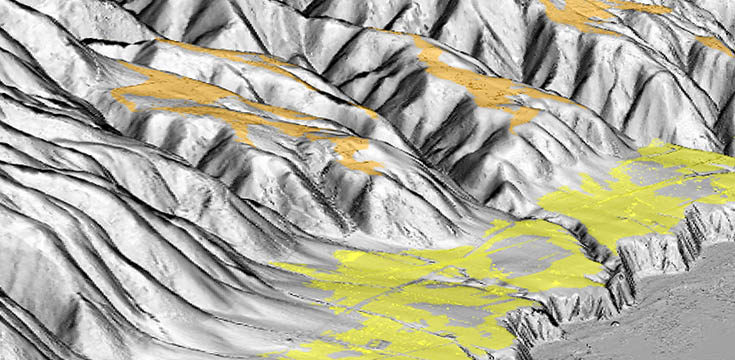
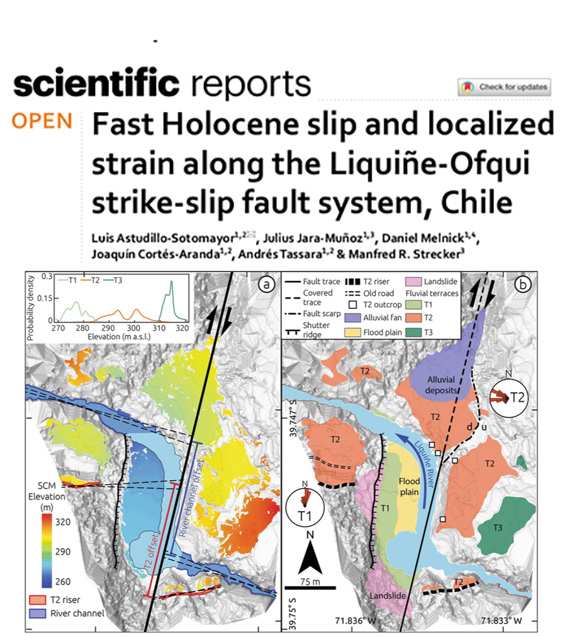
In active tectonic settings dominated by strike‐slip fault systems, slip partitioning along subparallel faults is a common feature; therefore, elucidating the degree of partitioning and strain localization is paramount for seismic hazard assessments. Here we used the surface classification model (SCM) of TerraceM to map the surface morphology of fluvial terraces. Then by measuring the offset between the maped fluvial terraces we estimated a slip rate of 18.8 ± 2.0 mm/year over the past 9.0 ± 0.1 ka for a single strand of the Liquiñe‐Ofqui Fault System. The fast millennial slip rate in the absence of historical Mw > 6.5 earthquakes along the Liquiñe‐Ofqui Fault System implies either a component of aseismic slip or Mw ~ 7 earthquakes involving multi‐trace ruptures and > 150‐year repeat times.
Friday 19 August 2022 kl. 18:49
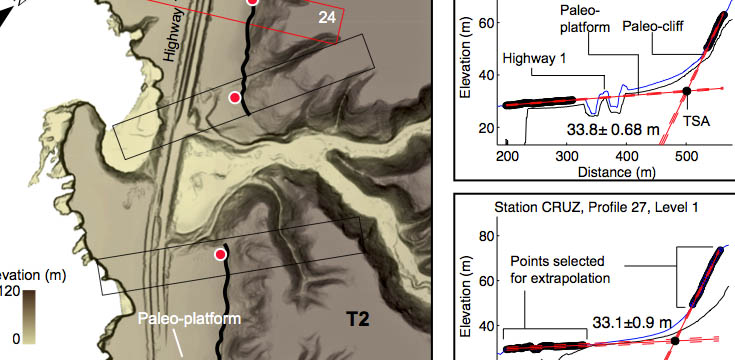
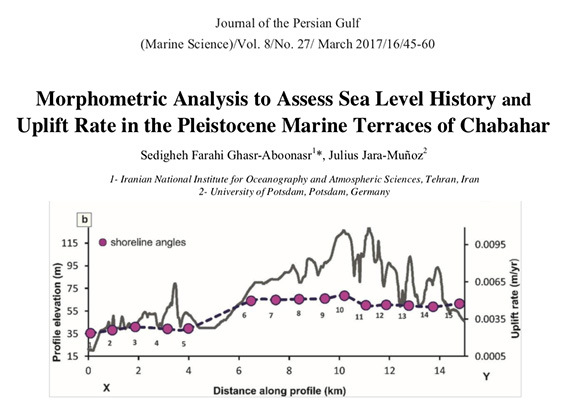
Marine terraces are strain markers that can provide crucial information to asses past sea-level changes in tectonically active coastal realms such as in the Chabahar Peninsula, Iran. Here TerraceM was used to accurately measure the elevation of marine terraces to elucidate their pattern of deformation along the strike. The TerraceM analysis allowed us to elucidate the location of active normal faults and their seismic potential.
Sunday 19 June 2022 kl. 19:02
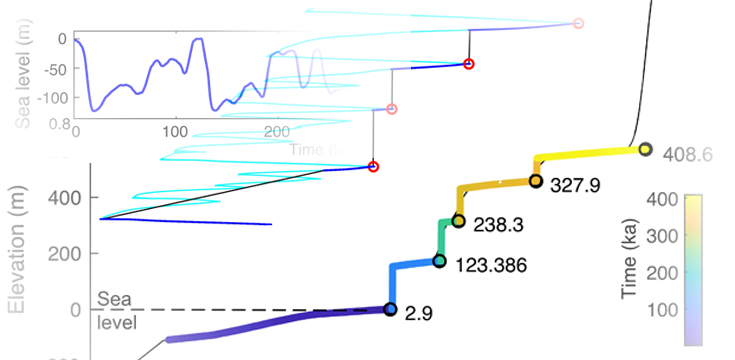
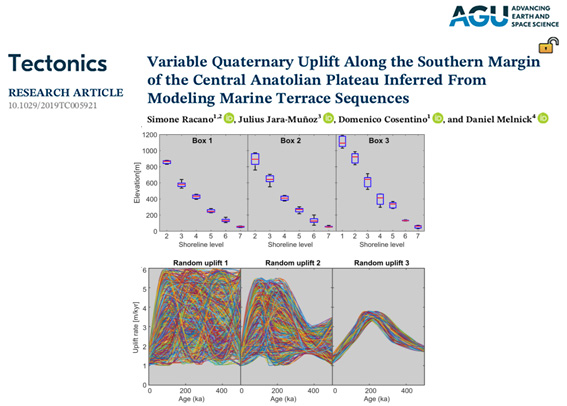
The southern margin of the Central Anatolian Plateau (CAP) records a strong uplift phase after the early Middle Pleistocene, which has been related to the slab break‐off of the subducting Arabian
plate beneath the Anatolian microplate. We used the TerraceM software to map the position and elevation of associated shoreline angles. Then we used the TerraceM Landscape Evolution Model that simulates wave erosion of an uplifting coast. Using random optimization algorithms and minimization statistics we find the input parameters that better reproduce the morphology of CAP marine terraces. The best‐fitting uplift rate history suggests a significative increase from 1.9 to 3.5 m/kyr between 500 and 200 kyr, followed by an abrupt decrease to 1.4 m/kyr until the present, which agree with slab break‐off models.