
1.1 Soaking
Two effects have to be achieved in soaking of cured hides: cleaning up of the surface of the hide and rehydration of the interior of the hides. Manure, urine and blood generally contaminate the typical hide. Animal skins are naturally contaminated with soil, dust and sand from normal activities of the animals during grazing and on the feedlot. Furthermore large amounts of salt have to be removed some of which adheres to the outside of the hide and the rest that is well penetrated in the entire cross section of the hide.
Salted hides, fresh hides and chilled hides all require several washings with fresh water under strong mechanical action for proper cleaning. Drums, mixers and paddles can be used and the wash float should be changed at least twice with fresh water after 30 to 60 minutes of drumming.
The effect of washing can be followed by observing the color of the wash float. The first wash float is brown and appears to have a high content of solubles and solids. The color comes from blood and from manure. With each change in float it becomes clearer and more colorless. Picture 1 shows the soaking process in a paddle.
Full rehydration of the fiber structure is a very most important precondition for all of the beamhouse operations. Liming cannot substitute for insufficient soaking. Salted hides need about 5 hours of drum soaking and dried hides and skins may need 24 hours or more. The hide has to reach as nearly as possible the state of suppleness it had when it was freshly flayed from the animal.
Soaking in the final rehydration float is currently enhanced by adding either 0,3% sodium hydroxide,
(NaOH), or surface active agents and sometimes proteloytic enzymes. In many cases small amounts of bactericides are added.
The addition of NaOH has to made properly. The purpose is only to adjust the float to a slightly alkaline pH. Addition of too much alkali and/or poor mixing may result in hair immunization. Elevated temperatures up to 32 °C speed up the soaking. The warmth helps to make the fiber structure more flexible however water uptake is somewhat less than it would be at 15 °C.
1.2 Hide and Skin Unharing and Liming
The process of unhairing is the first major step in leather making. The pelt has to be freed of the epidermis and hair, including the hair roots, and the keratinous material filling the hair follicles before proceeding with the next step.
The S-S bridges of the keratin can be split by reduction or oxidation quite selectively without influencing the collagen fiber network. The keratin structure may partially break down forming a pulp or dissolve completely, leading to a clean pelt surface with the assistance of mechanical action on the hides that can suspend the hair sludge and empty the hair follicles completely.
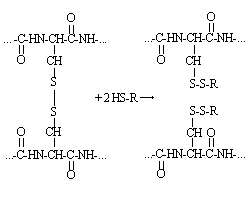
Reduction can be performed
by almost any kind of reductive agents, preferably under alkaline conditions.
The most widely used compounds are reductive sulfur- or thio- compounds. They
act by exchanging with one of the sulfur atoms in the disulfide bridge of
cystine (figure 2).
The most widely used unhairing agents used in the leather industry today are
sodium sulfide (Na2S) or the half neutralized form sodium hydrogen sulfide.
The unhairing process is usually not separated from the liming process. It
is generally done in a rotating vessel such as a drum or mixer in a float
containing 3 to 4 % lime hydrate (Ca[OH]2) and 1 to 3 % sodium sulfide technical
grade.
1.2.1 Swelling and Deswelling
Collagen behaves at low pH like a cation and at high pH like an anion (figure 3-6). Starting at the isoelectric point, if the pH is lowered by adding acid, the carboxyl groups lose their charge, while the amino groups have become neutralized repulsive forces between the excess positive charged amino group sidechains arise. These repulsive forces are the basis of swelling in acid.
In the alkaline region it is the reverse. The amino groups are neutralized by the addition of alkali and then the negatively charged carboxyl groups became predominant and create repulsive forces.

Collagen behaves at low pH like a cation and at high pH like an anion (figure 3). Starting at the isoelectric point, if the pH is lowered by adding acid, the carboxyl groups lose their charge, while the amino groups have become neutralized repulsive forces between the excess positive charged amino group sidechains arise. These repulsive forces are the basis of swelling in acid. In the alkaline region it is the reverse.
The amino groups are neutralized by the addition of alkali and then the negatively charged carboxyl groups became predominant and create repulsive forces.
Repulsion charges is the source of swelling. Swelling in the acid range is stronger than in the alkaline range because the carboxyl groups are uncharged only over a very narrow pH region, where all the amino groups are charged. Therefore a maximum of swelling occurs at a pH of 2,5 and slightly above. At lower pH the concentration of added counter ions became so high that this leads to deswelling.
The extent of swelling, measured by increasing thickness and uptake of water (which means an increase in weight) depends greatly on the given structure.
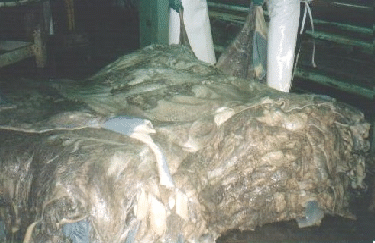
Hides from older animals are much more crosslinked and may swell much less than a hide of a young animal under the same conditions. Picture 4 shows swollen cattle hides after liming.
Alkaline swelling in the liming step increases with increasing alkali concentration, the duration of treatment and with lowering of the temperature. The degree of swelling is only a function of alkali concentration provided that sufficient liquid for water uptake is present.
1.3 Deliming, Bating and Pickling
After liming in strong alkali the alkalinity has to be reduced to neutrality, what is called deliming operation. The aims of deliming are eliminating swelling and the removal of mechanically deposited lime, chemically bound lime and of capillary lime by conversion into readily soluble salts.
The purpose of pickling is to acidify the pelts to a certain pH before chrome tannage and thus to reduce the astringency of the chrome tanning agents. Pickling is also used for preserving. Chemicals include 5 - 10 % of common salt (sodium chloride) or sodium sulfate and 0,6-1,5 % acid (sulfuric, hydrochloric, acetic or formic, or mixtures).
During neutralization of the pelts is the pickling unit the pH of the collagen has to be shifted to the isoelectric point and the state of swelling has to be changed.
Reversing swelling is much more difficult, because a hide swelled in sodium hydroxide cannot be reversed by offering strong acids. Therefore weak acids or acidic salts are used. Boric acid, ammonium sulfate, sodium bisulfate and very recently sodium bicarbonate or carbon dioxide have been proven in practice. They can be offered in excess without causing acid swelling. A most important point is, that the float should be as short as possible, to obtain the highest concentration possible of the neutralizing agents.
Bating is an enzymatic process which has the purpose of further loosening and peptizing of the fiber texture of the skin and elimination of alkali-swelling.
Enzymes are biological catalysts which accelerate the reactions without themselves being modified. They act specifically on proteins called proteases. Current enzymatic treatment employs 0,5 % bating material for 30 minutes up to 12 hours, replacing the age-old process which entailed treatment with dog dung or pigeon droppings. The bating material is typically composed of 50 % wood flour or other carrier, 30 % deliming agent (ammonium chloride), and 1 - 5 % pancreatic enzyme.
Temperature influences the bating effect. The rate of enzymatic reaction increases with rising temperature. Bating temperatures used in practice are about 30 - 37 °C.
Deswelling is enhanced by higher temperatures in the bath. Here it is wise to take advantage of the inverse temperature dependency of swelling. The enzymatic bating process completes not only the deswelling of the hide but also the process of deliming liberating additional calcium ions.
